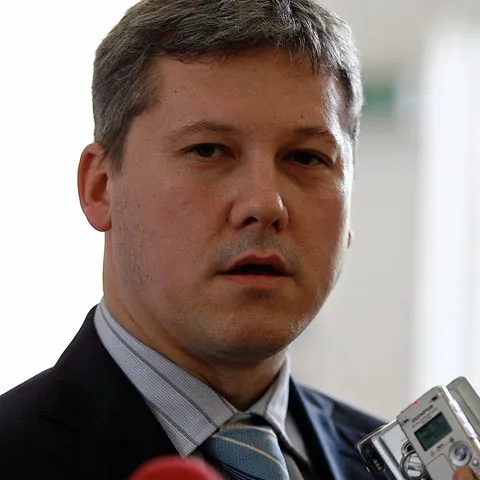
Romania’s justice minister Catalin Predoiu said at hearings in front of members of the Senate’s juridical commission that he was not asked by government colleagues before pick to take responsibility on the new justice Codes.
Leaders
of Romania's ruling coalition decided yesterday to take responsibility
for justice Civil and Criminal Codes in June after several meetings
with NGOs, appointing Victor Ponta and Daniel Buda in charge of
harmonizing all points of view regarding the content of the two
documents.
“I
was not consulted beforehand,” Predoiu said, adding he is pending a
meeting with the prime-minister before publicly uttering his stance
with respect to the issue. “I cannot comment on the political routes
that led to this decision,” he added, explaining his term in the
Cabinet is one predominantly technical. Predoiu is a lawyer and the
only minister not part of any political party. He served as justice
minister in the last few months of the outgoing Liberal government
whose term ended in December last year. He was kept on the post by the
new ruling Liberal Democrat (PD-L) and Social Democrat (PSD) alliance.
The
minister complained his stand on the issue has been thwarted by the
media and this did nothing but hurt the public debate on the two Codes.
Still the faster passing of the Codes will definitely count in the June
justice report carried by the European Commission. “The need to have
new Codes is unquestionable and no one has denied this,” Predoiu told
senators of the commission, pointing that the tendency to politicize
the issue could hit its credibility.
Moreover,
he pleaded for a compromise to have the Codes in the country’s Official
Gazette, warning over the intransigency of the EC on carrying out the
report.
Predoiu
pointed that triggering the safeguard clause is still a possibility and
pleaded for better applying of European norms in Romania which should
impede activating the clause.
Romania’s
Codes in the justice system date from the communist period, more than
20 years ago. The European Commission has many times criticized the
slow pace of reforms in Romania’s justice system and the inefficiency
in the fight against high-level corruption.
Romania
joined the European bloc at the beginning of 2007 with the promise to
root out corruption and carry serious justice reforms.
As
for the Codes, the Criminal and Civil ones spurred numerous public
rifts over some stipulations and caused disagreement between some of
the PSD representatives and colleagues from PD-L. NGOs in the field
also complained over what they call abuses inserted in the two
documents.
The other two codes including the procedures were delayed until the fall.