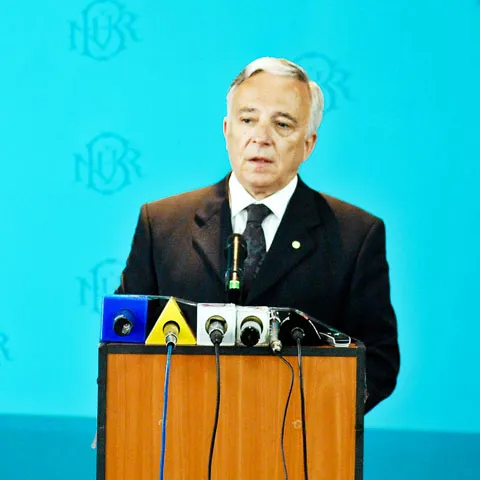
Increasing taxes in a bid to improve the economic unbalances could push inflation up, said the central bank's (BNR) governor Mugur Isarescu, who added a higher VAT can prompt an inflationary shock.
He
said the correction of external unbalances can be completed through the
exchange rate, through cutting credits or hiking taxes, but mentioned
all the three solutions can usher pressure on inflation.
Isarescu also mentioned the unbalances cannot be adjusted without tempering the economic growth.
The
governor declared that adjusting the external deficit to 5-6 percent of
the gross domestic product (GDP) at the end of the year is an excessive
measure and that could pave the way to a correction between 8 and 10
percent of the nongovernmental private sector.
He
mentioned that, besides using some instruments to adjust the current
account gap, there could show up some factors that cannot be
controlled, like the effects of the financial crisis.
BNR's
vice governor, Cristian Popa, estimated on June 23 that Romania's
current account gap could stand at 6 percent of the GDP this year.
Romania's
balance of payments deficit reduced 78.9 percent in the first four
months to 1.182 billion euros, after a significant shrink of the trade
gap and the high level of the current transfers surplus.
The
current account gap could narrow to 7.5 percent of the GDP this year,
from 12.4 percent in 2008, according to the last prognosis of Romania's
government and the International Monetary Fund (IMF).
BNR
decided yesterday to cut rates for minimum mandatory reserves from 18
to 15 percent for lei passives and from 40 to 35 percent for those in
foreign currency, measure which will set free 9 billion lei on the
banking market.
Isarescu
declared the amounts and the moments when BNR decides to release the
funds from minimum mandatory reserves will make the difference between
the success and the failure of these measures. He added the way in
which the central lender will release the funds will be tackled with
great responsibility to counter-balance the negative effects.
The
12 percent interests paid by banks for deposits are a luxury that will
be sanctioned very fast as they represent distortions related to both
the monetary policy rate and the inflation.
Interest
rates for deposits have to stand below the key interest rate of 9
percent, so banks can get the liquidity they need on short-term from
BNR's facilities, the governor concluded.