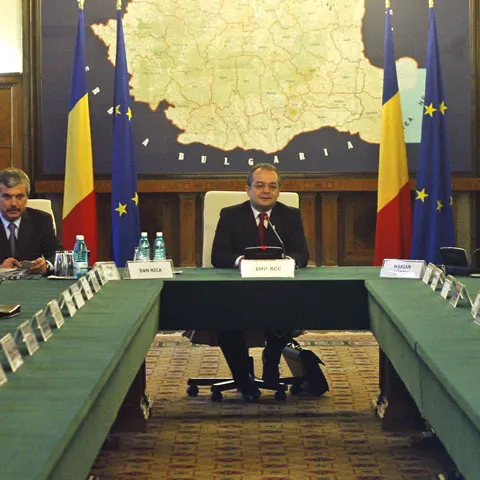
Romania’s Cabinet could take responsibility on the single salary law in a bid to apply it with January 2010 and freeze too big salaries and at the same time allow a temperate growth of the small wages, Premier Emil Boc said.
Employees
working in the public sector who earn more than the Romanian president
will not receive any salary hikes until 2015 and the largest salary
cannot exceed 15 times the one of a beginner in six years time,
declared for NewsIn people inside the government.
Leaders
of the governing parties agreed this morning on the principles to
establish the salary law in the public field and decided the proportion
between the smallest wage and the largest one to be of 1 to 15, down
from 1 to 72 as before.
“The
implementation of the new wage system will be completed in five years,
through differentiated salary hikes. The law will enter into force in
2010,” according to a document obtained by NewsIn.
The base salary will thus become the main element of the salary gain, after some general bonuses are incorporated.
Representatives
of the Labor Ministry declared for NewsIn that the deadline for
applying the law should be extended to 2015, given the unfavorable
economic background in 2009 and 2010.
However,
shifting from the current salary system to the new one will not allow
for anybody to see a slash in the gross salary calculated according to
the present regulations.
Vice-premier
Dan Nica said earlier the principles agreed upon today will be
discussed in the government meeting later today. He mentioned the
hierarchy will be completed according to the European salary system,
just like in Germany, France, Great Britain, Spain or Italy.
Nica
said the largest wage of an employee in the public system will be
15-fold higher the most than the smallest one. He also announced ruling
parties target that the sole salary law in the public sector starts to
impinges upon employees from 2010.
Premier
Boc said last week that Romania began negotiations with European
partners to find ways to finance the budget gap, which would diminish
the effects of the crisis. Negotiations ended with the promise of a
20-billion euro external loan from the International Monetary Fund and
other international lenders.
The
four conditions imposed by the IMF are enforcing the budget revision
bill by May 4, enforcing the singular salary system, the fiscal
responsibility bill and the pension system revision law, Boc said.