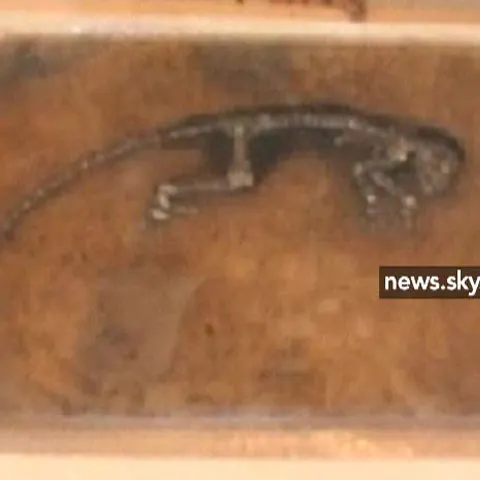

Ida este nici mai mult, nici mai puţin decât veriga lipsă din lanţul evoluţiei umane, aşa cum îl explicase Charles Darwin. Scheletul fosilizat, intact în proporţie de 95%, este cea mai veche fosilă de primată descoperită vreodată. Fosila aparţine unei maimuţe-lemur şi a fost prezentată într-o conferinţă de presă specială, la New York.
Ida a fost descoperită de un arheolog amator în anii '80 şi rătăcită prin mai multe muzee, până când a ajuns pe mâinile unui paleontolog norvegian, care a cercetat mai atent fosila.
1 EUR= 4.2821 RON 


Vîntu: Îi urez lui Băsescu să-l văd în...
Vîntu, reţinut pentru 24 de ore în dosarul...
Prognoza meteo 9 septembrie
Romii au sărbătorit Sfânta Maria la Costeşti
Un şofer beat a avariat 7 maşini
Udrea spune că dacă ar anunţa la ce funcţie...


Feedback
Aplica pe jobs.realitatea.net
[I]n the paper published in PLoS ONE from the Public Library of Science on the fossil [the author] is more circumspect. “Darwinius masillae is important in being exceptionally well-preserved and providing a much more complete understanding of the paleobiology of an Eocene primate than was available in the past,” the authors wrote.
“[The species] could represent a stem group from which later anthropoid primates evolved [the line leading to humans], but we are not advocating this here.”
The paper’s scientific reviewers asked that they tone down their original claims that the fossil was on the human evolutionary line.
One of those reviewers, Professor John Fleagle at Stony Brook University in New York state said that would be a judgment for the scientific community. “That will be sorted out or at least debated extensively in the coming years once the paper is published,” he said.(“Is Fossil Ida a Missing Link in Evolution?”, James Randerson, The Guardian, May 19, 2009)
New York Times afirma despre acelasi subiect: "[D]espite a television teaser campaign with the slogan “This changes everything” and comparisons to the moon landing and the Kennedy assassination, the significance of this discovery may not be known for years. An article to be published on Tuesday in PLoS ONE, a scientific journal, will report more prosaically that the scientists involved said the fossil could be a “stem group” that was a precursor to higher primates, with the caveat, “but we are not advocating this.”
All of this seems a departure from the normal turn of events, where researchers study their subject and publish their findings, and let the media chips fall where they may" (“Seeking a Missing Link, and a Mass Audience”,Tim Arango, The New York Times, May 19, 2009)
Principalul ziar austrian "The Australian" subliniaza faptul ca unul din principalli membrii ai echipei de cercetari in acest proiect nu este de acord cu afirmatia potrivit careia "Ida este veriga lipsa in demonstrarea evolutei umane" - University of New England paleoanthropologist Peter Brown remains skeptical. He pointed to a story in the Weekend Australian in which one of [coauthor Jørn] Hurum’s coauthors, University of Michigan paleontologist Philip Gingerich, said the team would have preferred to publish in a more rigorous journal such as Science or Nature.
Dr. Gingerich told the Wall Street Journal: “There was a TV company involved and time pressure. We’ve been pushed to finish the study. It’s not how I like to do science.”
“That rings all sorts of warning bells,” Professor Brown cautioned. He said that however it was prepared, the paper did not provide sufficient proof that Ida was the ancestral anthropoid.
“It’s nice it has fingernails, something we have, as do most primates . . . but they’ve cherry-picked particular character[istics] and they’ve been criticized (by other scientists) for doing that.”(“Scientists Divided on Ida as the Missing Link”, Leigh Dayton, The Australian, May 21, 2009)
-- Una din principale reviste stintifice din lume Live Science afirma ca - “On the whole I think the evidence is less than convincing,” said Chris Gilbert, a paleoanthropologist at Yale University. “They make an intriguing argument but I would definitely say that the consensus is not in favor of the hypothesis they're proposing.” . . .
“The PR campaign on this fossil is I think more of a story than the fossil itself,” said anthropologist Matt Cartmill of Duke University in North Carolina. “It’s a very beautiful fossil, but I didn’t see anything in this paper that told me anything decisive that was new.”
Most experts agree that the find is significant, if only for its impressive degree of completeness, but some were put off by the bells and whistles that went along with the publicity campaign around Ida. . . .
“It’s not a missing link, it’s not even a terribly close relative to monkeys, apes and humans, which is the point they’re trying to make,” [Carnegie Museum of Natural History curator of vertebrate paleontology Chris] Beard said.(“Amid Media Circus, Scientists Doubt ‘Ida’ Is Your Ancestor
Clara Moskowitz, LiveScience, May 20, 2009)
--- Alta revista de stiinta Science NOW explica "Many paleontologists are unconvinced. They point out that Hurum and Gingerich’s analysis compared 30 traits in the new fossil with primitive and higher primates when standard practice is to analyze 200 to 400 traits and to include anthropoids from Egypt and the newer fossils of Eosimias from Asia, both of which were missing from the analysis in the paper. “There is no phylogenetic analysis to support the claims, and the data is cherry-picked,” says paleontologist Richard Kay . . . of Duke University. Callum Ross, a paleontologist at the University of Chicago in Illinois agrees: “Their claim that this specimen should be classified as haplorhine is unsupportablle in light of modern methods of classification.”
Other researchers grumble that by describing the history of anthropoids as “somewhat speculatively identified lineages of isolated teeth,” the PLoS paper dismisses years of new fossils. “It’s like going back to 1994,” says paleontologist K. Christopher Beard of the Carnegie Museum of Natural History in Pittsburgh, Pennsylvania, who has published jaw, teeth, and limb bones of Eosimias. “They’ve ignored 15 years of literature.”(“‘Revolutionary’ Fossil Fails to Dazzle Paleontologists", Ann Gibbons, ScienceNOW, May 19, 2009)
---- Alta revista cunoscuta in lumea Stintei Live Science declara: "Science is supposed to be methodical, and usually it is, sometimes to the point of being dull. But there are times when a little hoopla is called for. Major discoveries that rewrite the textbooks deserve big headlines and ubiquitous media coverage and lots of scientific slaps on the back and all that.
The discovery of the “Ida” fossil, announced this week as though the 47-million-year-old lemur-like female were a rock star, seemed at first like one to celebrate.
Today we know better. . . . [T]here are doubts about whether [humans are] really descended from Ida. Problem is, most of the coverage is done, and the public could be left with the impression that Ida is a rock-solid missing link in the human evolutionary chain. . . .
“It’s not a missing link, it’s not even a terribly close relative to monkeys, apes and humans, which is the point they’re trying to make,” said Chris Beard, a curator of vertebrate paleontology at the Carnegie Museum of Natural History in Pittsburgh. . . .
The debacle started to unfold when the finding, cloaked in secrecy while a media engine was being primed, leaked out in The Wall Street Journal, and then in London’s Daily Mail. Then The New York Times wrote about the media circus that was to ensue. All this was published before anyone but the research team (and its tightly controlled media team) knew the details of the finding. . . .
Ida’s unveiling was highly scripted (with some “Barnum and Bailey aspects,” said paleontologist Richard Kay of Duke University). More important, it can now be said the findings may well have been significantly overstated. We won’t know for sure until further research is done. But if this event causes the public to distrust science and media, that distrust is well placed.(“Ida Fossil Hype Went Too Far”
Robert Roy Britt, LiveScience, May 20, 2009)
---Postul britanic de stiri BBC news: "Dr Chris Beard, curator of the Carnegie Museum of Natural History and author of The Hunt for the Dawn Monkey, said he was "awestruck" by the publicity machine surrounding the new fossil. . . .
But he added: "I would be absolutely dumbfounded if it turns out to be a potential ancestor to humans."(“Scientists Hail Stunning Fossil”
Christine McGourty, BBC News, May 19, 2009)
Parerea mea personala este ca, la fel cum reiese si din comentariul meu precedent (si cred ca s-a vazut asta prin articolele pe care le-am citat si care au un ton f critic cu privire la acest subiect) e imposibil ca sa spui despre aceasta "Ida" ca e "the missink link" in evolutie. Nu cred de fapt ca exista asa ceva si din cate stiu eu nu este nici o dovada serioasa pana acum ca sa dovedeasca asta. Multumesc scepticus:).
Aşadar, voi, cei care vă declaraţi atei, ce ne propuneţi ca model existenţial?